
Do Trees on My Property Have Rights?
By Peter Johnston | Saturday, January 10, 2026
We’re very comfortable with the idea of property rights. If you own land, you own what’s on it—or so we assume. The house, the driveway, the fence, the trees. They’re yours. And you can cut trees down, trim them back, or clear them out entirely.
But here’s an unsettling question worth sitting with for a moment: do the trees on your property have any rights at all?
Most of us would instinctively say no. Trees aren’t people. They don’t vote, pay taxes, or speak up at council meetings. From a legal standpoint, they’re assets—or sometimes obstacles—no different than rocks or soil.
And yet, that answer starts to feel thin the longer you think about it.
The trees on your property were likely there long before you arrived. They grew without your permission, filtered air you didn’t yet breathe, stabilized soil you didn’t yet walk on, and quietly shaped the land year after year. They moderated temperature, slowed runoff, sheltered wildlife, and connected underground through fungal networks we are only beginning to understand.
Ownership, in this light, starts to look less like control and more like custody.
This is where ecologist and philosopher Aldo Leopold challenges us to rethink our place in the world. Leopold argued that our ethical framework stopped too soon. We extended ethics from individuals, to families, to communities, to nations—but never fully to land itself: soil, water, plants, animals, and the systems that make life possible.
His “land ethic” proposed a simple but radical shift: humans are not conquerors of the land; we are members of a living community. And members, by definition, have responsibilities—not just privileges.
Seen this way, the question isn’t whether trees have rights in a legal sense. It’s whether we have obligations that go beyond what the law requires.
Modern environmental debates often default to the language of management. We talk about “resource management,” “forest management,” and “stormwater management,” assuming nature is something to be controlled, optimized, and corrected—preferably by experts with plans and tools.
A land ethic points us toward a different action: nurture rather than manage.
Nurturing begins with humility. It accepts that natural systems are not machines we fully understand. It values patience over constant intervention, restraint over efficiency, and long-term resilience over short-term convenience. A nurtured landscape is not tightly controlled; it is supported, protected, and allowed to function as a living system.
Think about how casually we describe land as “unused” or “vacant.” A forest becomes a “woodlot.” A wetland becomes a “problem.” A mature tree becomes a “risk.” Language matters. It reveals whether we see land as alive—or merely available.
This shift in perspective doesn’t demand paralysis or perfection. It doesn’t say never cut a tree or never build a home. It asks something more reasonable—and more challenging: before acting, ask whether the action maintains the integrity, stability, and beauty of the living system you’re part of.
That is Leopold’s test.
Stand on your property and look at the trees, you’re not just looking at landscaping. You’re looking at part of a larger fabric—one that doesn’t end at your property line or reset when ownership changes hands.
Climate change makes this impossible to ignore. Millions of small, legal, rational individual actions add up to collective harm. No single tree removal causes climate change. A mindset that treats land as inert, disposable, or endlessly manageable contributes directly to it.
So, do the trees on your property have rights?
A better question is: How do we relate to the land we depend on—do we exert control, or do we work in harmony with it?
A land ethic tempers our rights with responsibility. Reminding us that our role is not to dominate the living world, but to nurture it- that our time on any lands is brief, and the consequences of how we treat it are not.
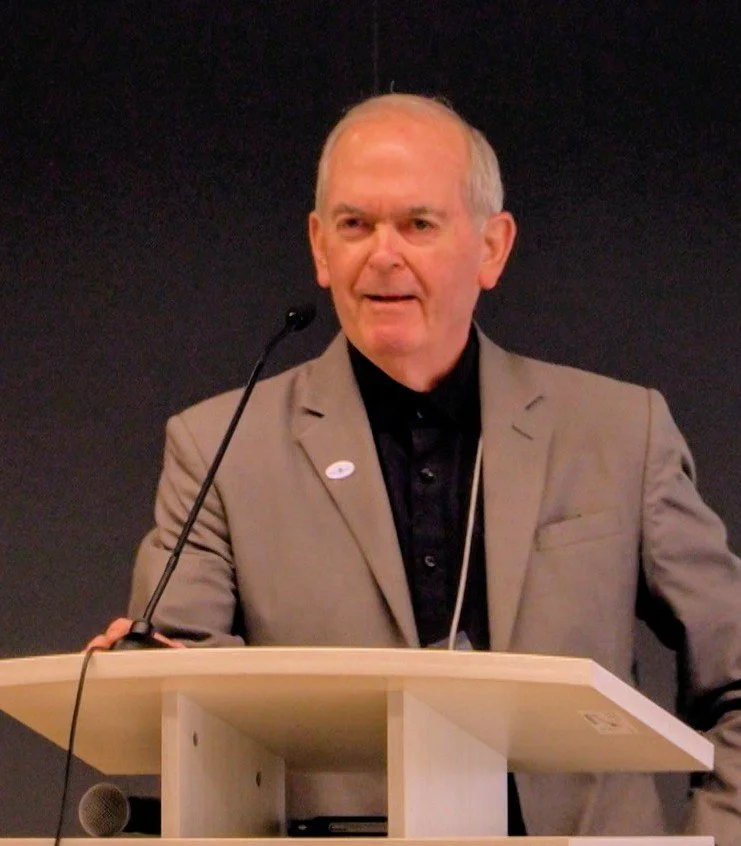
Peter Johnston
This is article No. 2 in the series of articles, Nurturing our Watersheds, from Muskoka Watershed Council. Its author is Peter M. Johnston, Gravenhurst resident, District of Muskoka councillor, member of Muskoka Watershed Council, and an individual who knows we can achieve great things if we work together. The series is edited by Peter Sale.
This article was first published by MuskokaRegion.com