
Integrated Watershed Management
“We are embarking, with municipal, First Nations, and community partners, on a journey to bring IWM to Muskoka watersheds. IWM offers a substantially more effective form of environmental management at the watershed scale through an effective collaboration in planning and policy development.”
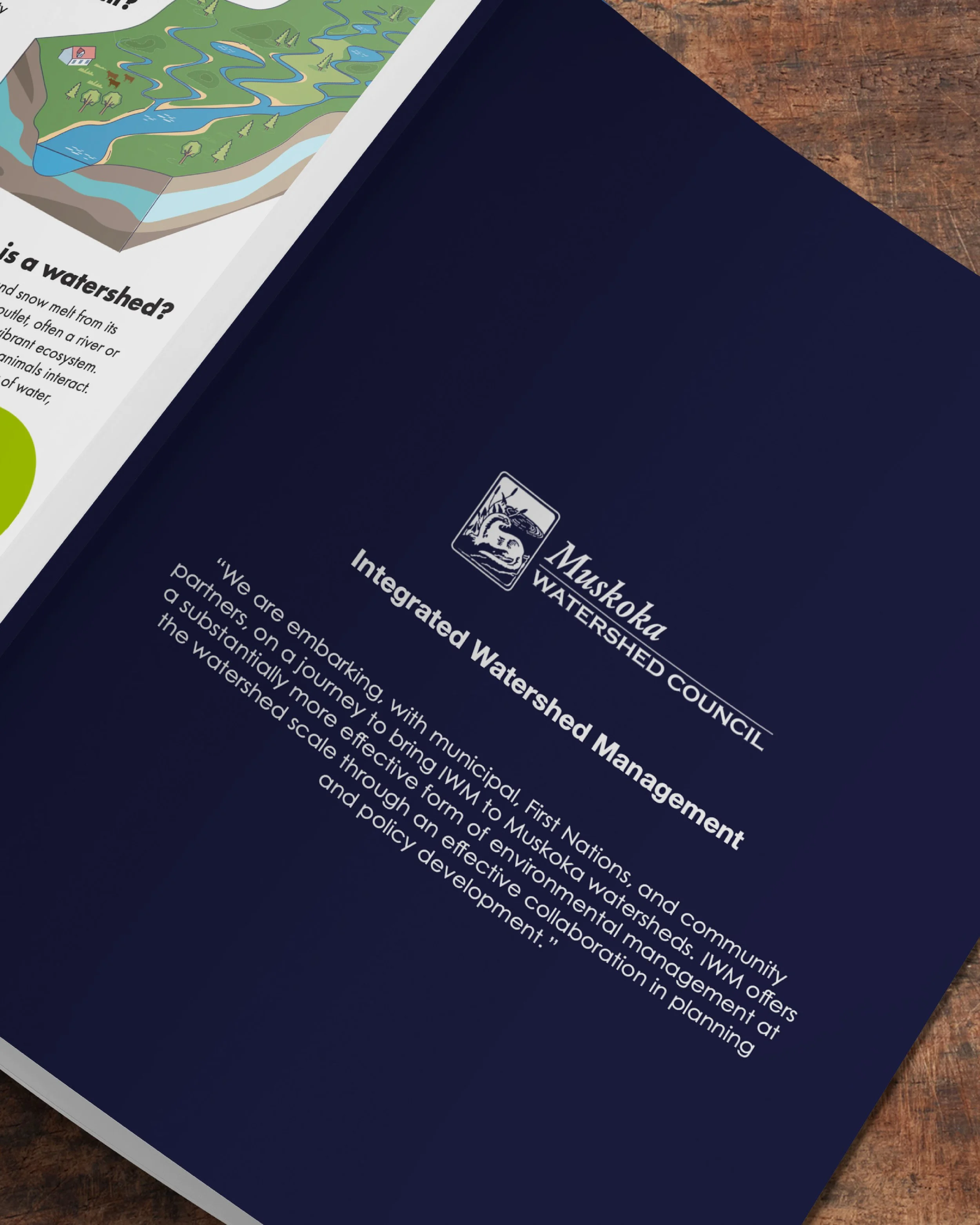
Integrated Watershed Management is an approach that requires us to manage human activities and natural resources together on a watershed basis, taking into consideration the connected interests and needs of the environment, economy, and society.
Our Current Way of Managing the Environment Wasn’t Designed for This
The environmental challenges we face today are more complex, connected, and urgent than ever before. Unfortunately, our current planning system was not built for this level of complexity—and it shows.
Decisions Are Made in Isolation: The Muskoka River watershed spans seventeen municipalities and First Nations communities—meaning decisions in one area, even well-intentioned ones like developing a shoreline or altering a wetland, will create consequences for other regions in the watershed.
The Muskoka River Water Management Plan is Outdated: The Muskoka River Water Management Plan (MRWMP) is too narrow in scope. The MRWMP focuses on balancing flows and levels for power production with navigation and several fish species. It is not designed for flood management, water quality or watershed health.
A Missed Opportunity for Collaboration: There is no shared framework for managing the watershed. As a result, we face gaps, overlaps, and missed opportunities. When each community acts alone, we miss the chance to pool resources, share knowledge, and solve problems more effectively and economically.
What we need now is a new approach—one that reflects how nature actually works, integrated and connected.
Integrated Watershed Management: Connecting Everyone is the Solution
Integrated Watershed Management (IWM) is a collaborative, community-based framework where everyone at the table—municipalities, NGOs, First Nations, residents, and businesses—work together on shared goals, including economic well-being.
IWM connects the dots between water, land, environment, economy and society. It helps each group see how their piece of the puzzle fits into the whole picture. It doesn’t override local authority—it enhances it. Every action taken locally considers the needs of the entire watershed. Everyone has a piece of the puzzle. Integrated Watershed Management is how we fit them together.
To learn more, read our Integrated Watershed Management brochure.
What a Successful IWM Plan Looks Like: A Collaboration Encompassing the Entire Watershed
An Integrated Watershed Management (IWM) Plan provides more than local solutions—it becomes a shared roadmap that unites our efforts across the entire watershed.
Establishes shared goals for clean water, resilient forests, and sustainable growth.
Defines roles and responsibilities among municipalities, landowners, industries, and community organizations.
Supports better, more coordinated decisions that consider long-term impacts and regional connections.
Measures progress and adapts as conditions change.
It’s not a new law or layer of bureaucracy. It’s a planning framework that enables communities to work together for the health of the watershed.
Key Benefits of IWM:
Adaptable and Flexible: IWM evolves with changing conditions, making it easier to respond to emerging challenges, including climate impacts.
Cost-Effective: By aligning efforts across the watershed, we create economies of scale, reduce duplication, and save money over the long term.
Vision-Driven, Not Crisis-Driven: IWM empowers us to set ambitious goals—like clean water, biodiversity, and sustainable land use—rather than constantly react to problems.
Climate-Ready: It supports proactive climate action by integrating environmental, social, and economic priorities into one coordinated approach.
Locally Rooted, Regionally Connected: Local decisions are made with a clear understanding of how they affect the broader watershed, ensuring we act in the best interests of the whole system.
How We’ll Make Decisions Together
Collaborative Governance in Action: At the heart of Integrated Watershed Management is a shared decision-making model—one that respects local authority while inviting meaningful participation from all corners of the watershed.
Equal Voices, Shared Responsibility: Community members, government, business leaders, Indigenous governments, and technical specialists will come together as equals at a watershed roundtable. Notably, the roundtable does not carry regulatory power. Instead, it creates a trusted space for collaborative problem-solving grounded in local knowledge, technical insight, and lived experience.
Municipal Leadership with Autonomy: Each municipality will retain full decision-making authority and autonomy. Recommendations from the roundtable will be passed to a steering committee made up of municipal representatives, who will coordinate how to implement these ideas locally through their existing planning and governance tools. This approach ensures that IWM supports, rather than replaces, local government processes.
A Network of Implementation: The success of IWM relies on shared implementation across sectors.
Beyond municipalities, a range of partners will play active roles:
Business and industry groups will contribute to sustainable practices and economic development, integrating watershed goals.
Scientific and technical organizations will provide data, models, and monitoring expertise.
Environmental stewards and ENGOs will help deliver projects on the ground.
Residents and landowners will contribute local knowledge and take direct actions in their communities.
Municipalities will have new tools to integrate watershed goals and needs into official plans, asset management and climate adaptation.
By weaving together these diverse voices and strengths, IWM becomes not just a plan—but a living framework for collective action.