
Does Nature have rights, and are they as important as our own?
By Bet Smith | November 29, 2025
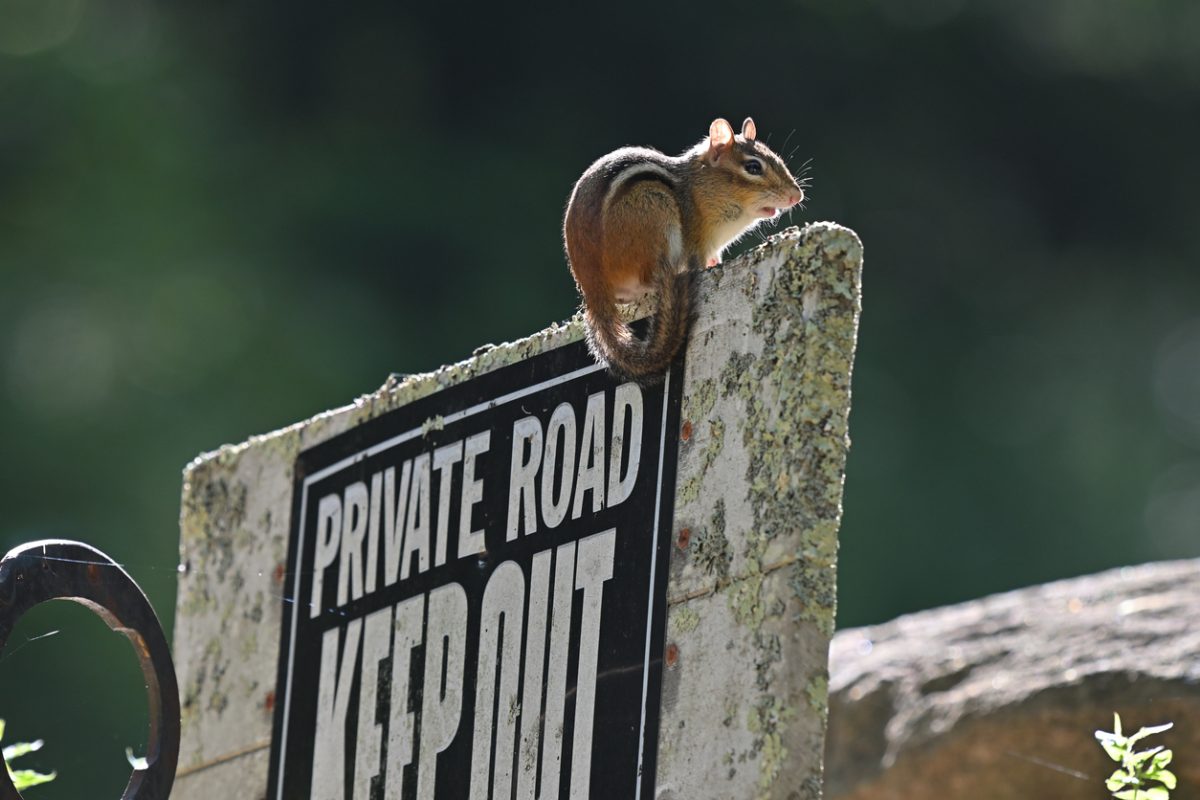
While riding his bicycle early this past summer, my partner stopped suddenly, launching himself from the bike and landing in an arm-breaking thud, all to spare the life of a baby chipmunk that had whizzed into the road. What ensued for my fella was a season of discomfort and deprivation, punctuated by doctors’ appointments. The chipmunk was safe, at least from one set of bicycle tires. My partner, on the other hand (who stopped to help a turtle cross the road while walking his mangled self home), missed out on some summer fun and the convenience of having two fully-functional arms. (And the turtle peed on him, too.)
While I’m not sure I’d advocate for this type of self-sacrifice, this story is my way of sneaking up on the topic of Nature’s rights vs. human prerogative. Does Nature have rights, and whose job is it to protect those rights? If respecting Nature’s rights limits industrial growth, urban development and recreation, at what point should we impose those limits?
We all know that Nature serves us in myriad ways, from providing oxygen, food, and resources to create shelter, to improving our mental health, bringing us moments of awe and providing a place for recreation and adventure. But do we see Nature’s value beyond the ways it serves us? Do we respect the rights of other creatures and organisms to exist and thrive well enough to limit ecosystem deterioration? (I have a hard time imagining anyone saying no to this, yet sprawl finds a way.)
Indigenous teachings often speak of reciprocity — that we must take only a little and find meaningful ways to give back. Reciprocity is a way of acknowledging Nature’s right to exist and thrive and to respect that other species’ lives have value. Settler culture has a long, long way to go before we can claim to have adopted the notion of reciprocity. We’ve racked up an enormous debt to the earth and have a few hundred years of giving back to do.
Earth is home to innumerable ecosystems that, as a whole, make up one great interdependent system. My fellow MWC members have written a great deal about Integrated Watershed Management, and I think we can apply this way of thinking on a global scale, investigating how our actions and decisions affect people, other animals and ecosystems far away. When we destroy habitats, we affect not only local but also global populations of at-risk and endangered species; migratory birds that cross in and out of human-made borders, or the salamander that only exists in one very special wetland. Our treatment of ecosystems has climate consequences as well; when we excavate a local wetland, we release stored carbon, contributing to the greenhouse gases that encircle the globe.
Seeing and smelling smoke from wildfires hundreds and thousands of kilometres away, and witnessing the health consequences, shows us how reliant we are on the stability of ecosystems elsewhere. While less visible than smoke, carbon emissions from wildfires further exacerbate fires, floods, storms and droughts. We feel a communal sense of loss when we see how wildfires destroy habitats and gravely impact communities and economies, but does our mindset change when we swap wildfires with bulldozers, paving trucks and cement mixers? These destroy habitat and can impede Nature’s ability to thrive by breaking vital ecological connections.
Many Canadians take pride and find a sense of identity in our vast and diverse natural landscape. I think Canadians ought to earn that sense of pride and place by actively protecting the watersheds that make up our national landscape. We should do this not only for our own benefit. Nature has a right to thrive, and all of humanity deserves a stable climate and healthy environment that Canada can help restore and preserve.

This is article No. 23 in Living Smarter in Muskoka, the series by Muskoka Watershed Council. Its author is Bet Smith, a passive house builder, blacksmith, and songwriter, who grew up mostly in Muskoka. Bet is a Member of MWC who helps our scientists explain what they mean. The series is edited by Peter Sale, Director and a former Chair, MWC.
First published by MuskokaRegion.com